Heillange
And Their Children After ThemHeillange is a town built around the steel industry and left to reckon with its decline. Its steep streets, aging public spaces, former industrial routes, and dispersed workplaces make economic history part of everyday geography. For Anthony Casati, the town is at once a place of constriction and the landscape he knows most intimately; for Hacine Bouali, it remains home even after an absence. Its changing prospects—industrial, commercial, and recreational—never erase the physical traces of what came before.
Setting and urban form
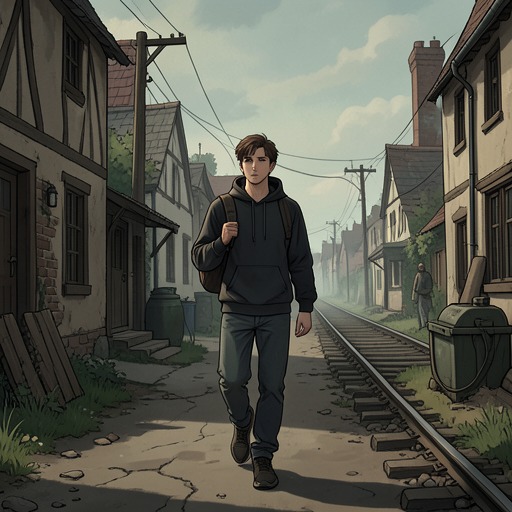
Heillange sits awkwardly across a hillside and beneath a bridge, with streets that rise and fall between downtown and the neighborhoods above it. Anthony’s early ride down rue Clément-Hader captures this steepness: at night the street is empty, and the descent carries him through a town that seems nearly lifeless. Elsewhere, the ZUP Residential District spreads through courtyards, parking lots, flower beds, grassy mounds, and benches marked with graffiti. From there, the valley viaduct frames the movement of cars travelling toward or away from Paris, a fast route past a town whose inhabitants remain amid its slower routines.
The built environment holds different versions of prosperity side by side. Anthony’s parents have achieved their lifelong goal of owning a house, though twenty years of mortgage payments remain. Their one-story home has Sheetrock walls, electric heating that brings steep winter bills, two bedrooms, an eat-in kitchen, a leather sofa, and a sideboard with embroidered linens. In the streets, by contrast, there are downtown apartments rented cheaply to professors and prefecture officials, as well as palatial houses left vacant after noncommissioned officers depart with their regiment. The town’s residential landscape registers aspiration, modest security, and abandonment without resolving them into a single story of decline.
Steelmaking and its aftermath
For a century, Heillange’s blast furnaces consumed people, time, and raw materials. Carts brought in fuel and ore; ingots left by train before travelling by waterways across Europe. The mill’s network of roads and canals channelled goods through the region, but also drained parts of the town. Its furnaces worked through the night, and interrupting production was considered too costly; workers were pulled from their beds and families to keep the operation running. The industrial past is therefore not just a source of local pride but a record of exhaustion and sacrifice.
By the time Anthony knows the story, the mill has become a remnant: reddish industrial shapes behind a fence secured with a small padlock. An art opening has been held on the site, a political candidate has proposed a theme park, and children now damage the abandoned structures with slingshots. Overgrown railway tracks, fading billboards, and bullet-riddled street signs make absence visible around them. Metalor’s closure has remained a reference point for a decade, and the town’s public language often returns to crisis, poverty, and social breakdown. Anthony resents the way memories of the ironworks can make every later enterprise seem trivial and leave younger people feeling that they missed the era when the town’s history seemed consequential.
Work, neighborhoods, and social life
The industrial contraction has not left Heillange without work, but it has made employment insecure and uneven. Anthony moves through a succession of temporary jobs, cleaning clinics and slaughterhouses, working as a school janitor and later on a kitchen crew at the prefecture. For eight weeks, he rises early to drive sixty miles each way for four hours of work, earning barely four thousand francs a month. He then cycles through nursing homes and several warehouses and workshops before finding a more or less permanent position at Gordon.
At Gordon, Anthony stacks metal sheets, rods, and grillwork into precise loads, which forklifts carry into ovens heated to more than two thousand degrees. The factory makes air conditioners for sale across Europe, but supervisors watch workers closely and temporary employees can be dismissed at the slightest downturn. Above them sit the engineers, executives, and bosses, who appear at the canteen as members of a different world. Anthony’s friendships with Cyril and other co-workers offer ordinary companionship—shared meals, breaks, and evenings together—but they also make visible a common anxiety about the future and about repeating their fathers’ lives in a town they had once wanted to leave.
The ZUP Residential District has its own rhythms. A fairground returns each year with a bumper-car carousel and a waffle stand; Hacine and his friends spend long days there, and Anthony finds Eliott in the courtyard after buying breakfast on his way uphill. The district’s residents watch Anthony and his mother cross its open spaces in silence after a visit to Malek Bouali. These details place everyday sociability beside the separation between neighborhoods and the unease of being observed as visitors.
Reinvention, return, and departure
Heillange’s leaders present recreation as a possible alternative to the old industrial identity. The sailing club and its campground are offered as evidence of the Henne Valley’s potential: the campground has been improved and is nearly full, and an aquatic complex—with a wave pool, waterslide, and twenty-five-meter pool—is planned for the next year. The pitch draws on the lake, forests, countryside, sunny summer weather, highways, and proximity to Luxembourg and Germany, as well as prospective subsidies from the region, Paris, and Brussels. It promises a future organized around leisure rather than production. The enthusiasm is genuine, but it coexists with the town’s unresolved memory of industrial loss and the uncertain work that followed it.
Hacine’s return shows how a familiar town can change without feeling wholly different. After leaving Morocco, he drives around below the ZUP towers and recognizes its courtyards and shaded places, although the fairground carousel and familiar faces are absent. He delays going to his father’s home, then walks downtown and notices a new kebab stand, a video game store, an abandoned bus shelter, and fresh billboards advertising Parisian perfumes and cheap shoes. From a café terrace on Place des Flamands, he watches ordinary summer life and savors the calm of streets he knows. He feels important as someone who has been away, yet Heillange remains the place to which he has returned.
Other returns make the town’s small scale palpable. When Stéphanie Chaussoy comes back for a short visit, she recognizes the Metro, the Commerce brasserie, small shops, the post office, City Hall, the bridge over the Henne, and her old school. She feels both pleasure and distance: the landscape is familiar, but she now belongs elsewhere and carries herself as someone passing through. At another point, Anthony declares that he does not want to return and will not come back. The contrast between his refusal and Hacine’s homecoming makes departure less a clean escape than an unsettled relation to place.
Public gatherings and narrative significance
Heillange’s public spaces also bring together groups that rarely become a unified community. At Luc Grandemange’s funeral, nearly three hundred people walk from Saint-Michel d’Heillange Church to L’Usine. The route turns a formal ceremony into a procession through town: residents come out to watch, some join because they recognize the deceased’s name or hope for a free drink, and joking gradually eases the crowd’s nerves. Anthony walks with his cousin and Vanessa while his parents move ahead side by side, not speaking much but no longer arguing. The streets briefly hold together people, family tensions, and local routines that otherwise remain scattered.
During the 1998 World Cup, the lakeshore likewise draws an unusually broad cross-section of the population: unemployed residents, executives, young motorcyclists, families, workers, shopkeepers, and people from the projects arrive in large numbers, parked along the highway, in fields, and in the forest. After France reaches the final, Heillange’s streets fill with cars, flags, painted faces, firecrackers, beer, and embraces between strangers and police officers. The celebration gives residents a shared pronoun and a momentary sense of strength after decades of bad luck. Algerian flags appear alongside the French tricolors, even as the local National Front office closes its shutter. The scene does not settle the town’s divisions; it shows how a common public event can briefly place otherwise divided lives alongside one another.
Heillange consequently functions as more than a backdrop to the characters’ choices. Its routes carry Anthony from childhood familiarity toward the prospect of departure; its workplaces show how economic change enters daily life; and its returning residents reveal the emotional pull of a home that offers neither an untouched past nor a secure future. The town’s defining tension is between the promise of movement and the persistence of place.